Is Cellulite Subcision Permanent? What the Evidence Says
Updated: Sep 19
Short answer: medical subcision gives long-lasting, and in many patients effectively permanent, improvement in cellulite dimples, because it physically releases the fibrous bands that cause them, and released bands do not reattach. The published follow-up data run to three years and beyond with results holding. What subcision does not do is stop new dimples forming elsewhere with age or weight change, so "permanent" needs a precise definition, which I set out below.
Why cellulite comes back after most treatments
Cellulite dimples are not a fat problem. They are caused by tight fibrous bands (septa) that run from the skin down to the deeper tissue and tether the skin at fixed points. When the fat between those tethers pushes outward, the anchored points stay pulled in. That is the dimple.
Creams, massage, radiofrequency and shockwave therapy act on the surface layers or on circulation. They can make skin look smoother for a while, but none of them cuts the band. When the temporary effect wears off, the tether is still there and the dimple returns. This is why those treatments are sold as courses of repeated sessions.
What subcision changes
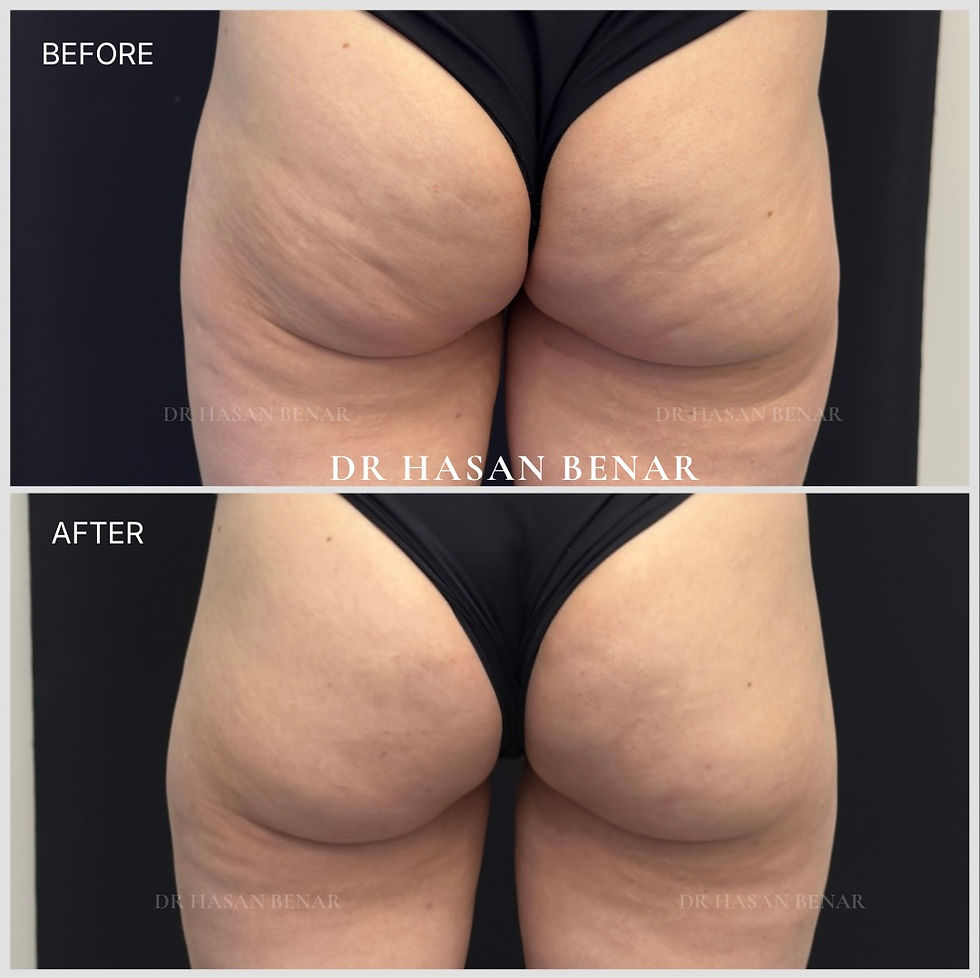
Subcision is a minor medical procedure performed under local anaesthetic. Using a fine instrument beneath the skin, the doctor releases the specific fibrous bands under each treated dimple. Once a band is cut, the skin above it is no longer anchored, and it settles level with the surrounding surface. Because the band has been divided rather than stretched or heated, there is nothing left to pull the dimple back.
In my practice at 54 Harley Street, the procedure typically takes 30 to 45 minutes depending on the area, and most patients need a single session for the treated dimples.
What the studies show about how long results last
Subcision is not new. It was described as a cellulite treatment in the dermatology literature over two decades ago, and the mechanism has been studied since (Hexsel and Mazzuco, International Journal of Dermatology, 2000).
The strongest long-term data come from the trials of vacuum-assisted, standardised subcision (marketed as Cellfina). In the multicentre pivotal study, improvement was maintained at every follow-up point, and a later publication reported that results were still present at three years, with the large majority of patients still satisfied and no reported reattachment of released bands (Kaminer et al., Dermatologic Surgery, 2015 and 2017). On the basis of that follow-up, the device's regulatory clearance for duration of results was extended from two years to three, and then further.
The important point for patients is that these studies measured the same dimples over time. The treated dimples stayed released. That is what "permanent" means in this context.
What "permanent" does, and does not, mean
It is honest to be precise here, because this is where expectations go wrong.
Treated dimples: long-lasting; in most patients they do not return, because the band is gone.
New dimples: subcision does not prevent new cellulite forming in untreated areas. Skin laxity with age, significant weight fluctuation, hormonal changes and genetics can all produce new dimpling later.
Skin quality: if the skin is very loose or thin, releasing the bands improves the dimple but will not tighten the skin. In those cases I may recommend a combined plan.
So the accurate statement is: subcision permanently releases the bands it treats; it does not make you immune to cellulite for life.
Who gets the most durable results
From more than 1,000 cellulite subcision cases, the patients who do best share a few features: clearly defined dimples (rather than diffuse "orange-peel" texture), reasonably good skin tone, stable weight, and realistic goals. A clinical examination is the only reliable way to tell whether your dimpling is band-driven, which responds to subcision, or predominantly laxity-driven, which needs a different approach.
Recovery and what to expect after treatment
Bruising and tenderness for a few days to a couple of weeks are normal and expected. Most patients return to daily activities immediately. Early improvement is visible within a few weeks once swelling settles, and the result continues to refine over the following months as the skin adapts.
Safety
Subcision involves the subcutaneous tissue and should only be performed by a medical doctor. At our clinic every procedure is doctor-performed, in a CQC-registered environment, following UK medical and ethical standards. Risks, such as bruising, swelling, temporary discomfort and, rarely, small irregularities, are minimised by correct technique and patient selection.
The bottom line
If your cellulite is made of distinct dimples, medical subcision is the only widely used treatment that removes the cause rather than masking it, and the published evidence shows the treated dimples stay improved for years. Book a consultation for cellulite treatment in London and we will examine your skin, tell you plainly whether you are a good candidate, and what result you can realistically expect. The consultation fee is £80 and is deducted from the treatment price if you go ahead.
Frequently asked questions
Does cellulite come back after subcision? The treated dimples generally do not return because the fibrous band has been released. New dimples can form in other areas over time with age or weight change.
How many sessions of subcision are needed? Usually one session for the treated area.
How long do results take to show? Early improvement within a few weeks; the final result settles over three to six months.
Is subcision better than Cellfina? Cellfina is a standardised, vacuum-assisted form of subcision; both release the bands. The choice depends on the pattern of dimpling and clinical assessment.
References
Hexsel DM, Mazzuco R. Subcision: a treatment for cellulite. International Journal of Dermatology. 2000;39(7):539-544.
Kaminer MS, et al. Multicenter pivotal study of vacuum-assisted precise tissue release for the treatment of cellulite. Dermatologic Surgery. 2015;41(3):336-347.
Kaminer MS, et al. A multicenter pivotal study to evaluate tissue stabilized-guided subcision using the Cellfina device for the treatment of cellulite with 3-year follow-up. Dermatologic Surgery. 2017;43(10):1240-1248.
Dr Hasan Benar is a GMC-registered dermatologist, practising at Dr Elif Clinic, 54 Harley Street, London W1G 9PZ.


Comments